From Local Action to Provincial Policy
How Young Voices Shaped Utrecht's Water Future through Duurzaam Utrecht 2030
Policy documents can often feel abstract, but real change happens when local stories meet regional decision-makers.
During my internship with
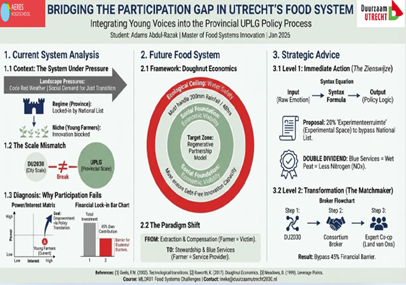
Duurzaam Utrecht 2030 (DU2030), our team set out to address a critical challenge in the Utrecht Programme Countryside (UPLG): how to handle extreme weather while supporting the next generation of farmers.
Treating water retention as an unexpected calamity creates uncertainty for agricultural communities.
Through a structured policy sprint, we brought together young farmers, students, and local experts to draft a formal consultation response (Zienswijze). We argued for clear water mapping, fair recognition of ecosystem services, and active local participation.
The Province of Utrecht recently released its official response (Nota van Beantwoording), and the impact of our input is clear:
- The province in Point 1325 of its response acknowledges our warning about severe downpours, noting that 10% to 15% of polder space will be needed for water collection. These low-lying areas are now explicitly mapped on Map 4, giving communities a clear reference point for future spatial planning.
- Also, Point 1326 responds directly to our call for bottom-up expertise. The province has formally committed to research by design, utilising integrated teams. This gives DU2030 and young farmers a direct seat at the table in upcoming area processes.
This outcome proves that participatory methods work. By bridging the gap between young agricultural leaders and provincial policy, we helped shift the conversation from reactive crisis management toward long-term stewardship.
A huge thank you to Ineke Malsch, the DU2030 team, every young farmer, student and citizen who contributed their time and insight to this effort. Onward to the implementation phase!
#FoodSystems #Sustainability #Utrecht #WaterManagement #YouthInPolicy #DU2030